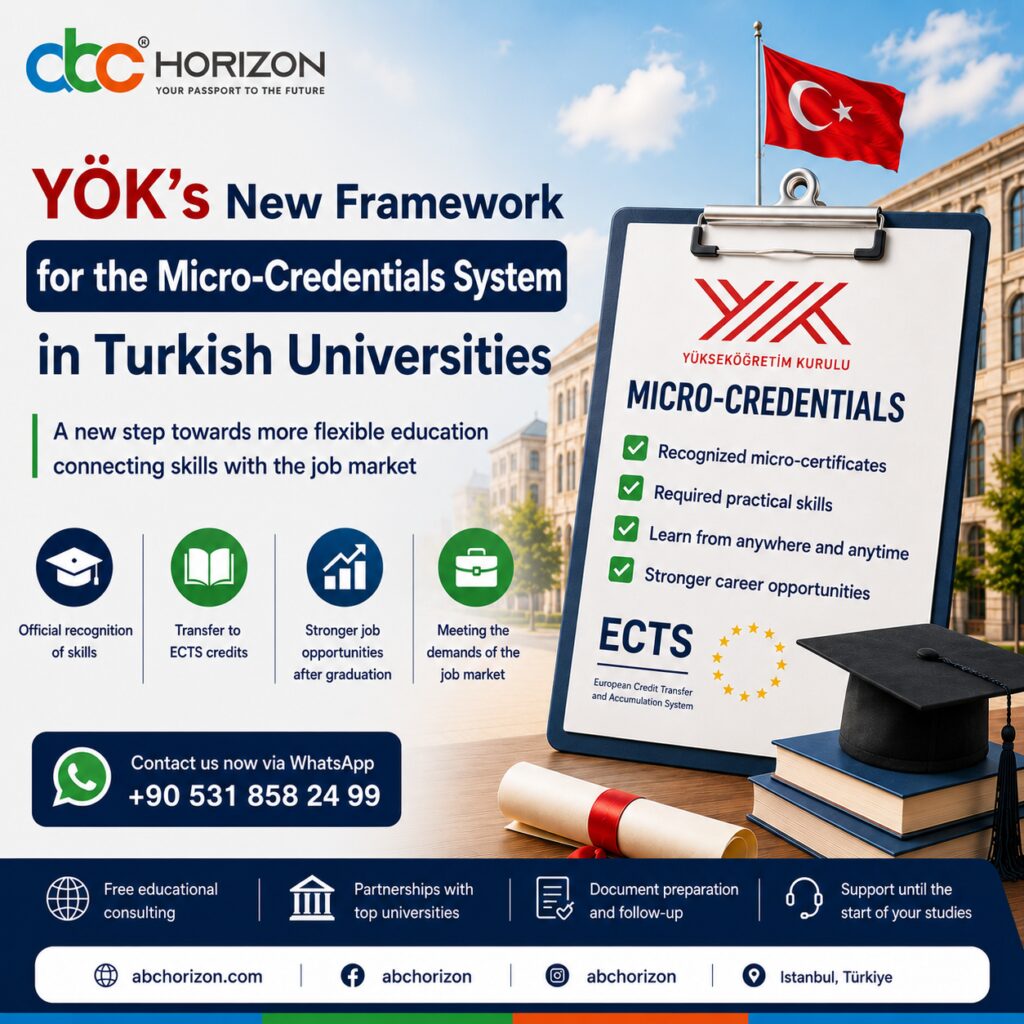
The Micro-Credentials System in Turkish Universities: How YÖK's New Framework Is Shaping the Future of Higher Education in Türkiye
Last Updated: 2026
The Turkish Council of Higher Education (YÖK) has introduced a new Micro-Credentials Framework for higher education institutions across Türkiye. This initiative aims to provide official recognition for selected skills, knowledge, and qualifications that students acquire outside traditional university degree programs. Subject to each university's academic regulations and quality assurance procedures, these competencies may be evaluated and converted into academic credits under the European Credit Transfer and Accumulation System (ECTS).
This framework represents much more than an administrative update. It reflects a significant transformation in Türkiye's higher education system by promoting a more flexible, skills-oriented approach to learning. Rather than relying solely on conventional university coursework, the new framework encourages the integration of practical, career-focused competencies alongside academic qualifications. For international students considering studying in Türkiye, understanding this development has become increasingly important when choosing a university or academic program.
For Arab students planning to study in Türkiye, this new framework opens the door to a more flexible educational pathway. Students pursuing degrees in Business Administration, Information Technology, Artificial Intelligence, or Cybersecurity may, subject to their university's regulations, strengthen their academic profile through short professional certifications and practical skills directly related to their field of study. This approach can significantly enhance both their academic experience and their career prospects after graduation.
What Is the Micro-Credentials System?
Micro-Credentials are short, competency-based certifications or qualifications that verify a student's achievement of specific skills or learning outcomes in a particular field. These skills may include data analytics, project management, digital marketing, cybersecurity, artificial intelligence, digital accounting, human resource management, and many other practical disciplines that are highly valued in today's job market.
The core idea behind the Micro-Credentials framework is that students are no longer limited to traditional university education alone. Instead, they can build a broader portfolio of professional skills alongside their academic degree. If these short-term certifications are issued by recognized providers, include clear assessment methods, and align with specific learning outcomes, universities may evaluate and recognize them within the academic system according to their own institutional regulations.
However, it is important to understand one key point: the framework does not mean that every online course will automatically be converted into university credits. Recognition depends on several factors, including the university's academic policies, the quality of the learning program, the assessment methodology, and how closely the certification relates to the student's field of study.
Why Has Türkiye Introduced This Framework?
The global job market has changed dramatically in recent years. Employers are no longer looking only for graduates with university degrees—they increasingly seek candidates who possess practical, job-ready skills. As a result, higher education institutions worldwide are integrating lifelong learning, professional development, short-term certifications, and digital competencies into their academic models.
Through the Micro-Credentials framework, Turkish universities aim to keep pace with these international trends. Students can strengthen their academic journey by completing high-quality short courses related to their major while studying at university. This enables graduates to develop stronger professional profiles and gain practical expertise beyond traditional classroom learning.
In addition, aligning Micro-Credentials with the European Credit Transfer and Accumulation System (ECTS) further strengthens the compatibility of Türkiye's higher education system with European academic standards. This is particularly valuable for international students planning to work abroad or pursue postgraduate studies after graduation.
What Is the ECTS System?
The European Credit Transfer and Accumulation System (ECTS) is the standard academic credit system used across the European Higher Education Area. It measures the total workload required to complete a course or program, taking into account lectures, independent study, research projects, assignments, examinations, and other learning activities—not simply classroom hours.
When Micro-Credentials are linked to the ECTS framework, they gain greater academic value and transparency. This does not mean that every short certificate will automatically receive university credit; rather, it provides universities with a structured framework for evaluating external learning achievements in a consistent and quality-assured manner.
Traditional Higher Education vs. the Micro-Credentials Framework
| Category | Traditional System | Micro-Credentials Framework |
|---|---|---|
| Learning Source | Primarily university-based education | Learning inside and outside the university, subject to institutional policies |
| Learning Format | Long academic courses | Short, skill-focused, competency-based learning |
| Flexibility | Limited flexibility | Greater flexibility in academic and professional development |
| Connection to Employment | Mainly degree-oriented | Strong emphasis on workplace skills and employability |
| Academic Recognition | Official university transcript only | May also be recorded in academic transcripts and Diploma Supplements |
How Can International Students Benefit?
International students planning to study in Türkiye need more than simply choosing a university—they need an academic pathway that prepares them for long-term career success. The Micro-Credentials framework supports this goal by encouraging students to acquire additional professional competencies alongside their university studies.
For example, a Business Administration student can strengthen their profile by earning certifications in leadership, digital marketing, project management, or data analytics. Likewise, a Software Engineering student can enhance their expertise through professional learning in cloud computing, mobile application development, cybersecurity, or artificial intelligence.
This combination of academic education and practical skills makes graduates significantly more competitive in the global job market compared to those who rely solely on traditional university coursework.
Which Academic Fields Will Benefit the Most?
Although the Micro-Credentials framework can support students across many academic disciplines, it is expected to have the greatest impact on fields that require continuous professional development and rapidly evolving technical skills—particularly Business and Computer Science.
Business Programs
Business-related disciplines are among the strongest beneficiaries of Micro-Credentials because today's business environment evolves rapidly. Students are expected to develop competencies in management, communication, leadership, strategic thinking, marketing, financial analysis, and business law in addition to their university education.
Students interested in this field can begin by exploring our Business Administration programs in Türkiye, where they can learn more about available specializations, internationally recognized qualifications, and academic pathways designed to prepare graduates for today's global business environment.
One of the key pathways within this field is Accounting and Finance in Türkiye, where Micro-Credentials can support essential skills such as financial analysis, digital accounting, risk management, and financial reporting.
Studying Business Administration in Türkiye is also a suitable choice for students who want to understand modern management, entrepreneurship, strategic planning, and organizational leadership.
Students interested in employee management and workplace development can explore Human Resources Management in Türkiye, a field that benefits greatly from skills in training, recruitment, leadership, and performance management.
In the age of digital transformation, Digital Marketing in Türkiye has become one of the academic fields most closely connected to short professional certifications, especially in areas such as search engine optimization, digital advertising, audience analysis, and campaign management.
Students who are interested in working in supply chains and logistics can explore Procurement and Supply Management in Türkiye, where Micro-Credentials can support key skills such as negotiation, planning, inventory management, and operational analysis.
Business Law in Türkiye is suitable for students who want to combine legal knowledge with the business environment, especially in contracts, compliance, and commercial arbitration.
Computer Science and Technology Programs
Computer Science and Technology programs are expected to benefit the most from the Micro-Credentials framework because the technology sector evolves at an extraordinary pace. Students in these fields must continuously update their knowledge and technical skills in areas such as software development, networking, cybersecurity, data analytics, cloud computing, and artificial intelligence to remain competitive in the global job market.
Students interested in this field can begin by exploring Information Technology programs in Türkiye, a broad discipline that covers computer systems, database management, technical support, digital infrastructure, and enterprise IT solutions.
Computer Science in Türkiye is also suitable for students who want to combine programming, computer systems, hardware, and networking.
Software Engineering in Türkiye is one of the academic fields that can be strongly supported by Micro-Credentials in areas such as web development, mobile applications, software testing, and DevOps.
With the growing importance of data protection, Cybersecurity in Türkiye has become one of the most in-demand fields worldwide. Students can further develop their skills through short professional certifications in network security, penetration testing, and risk management.
Another rapidly growing discipline is Data Analytics in Türkiye, a field that is closely connected to statistics, database management, artificial intelligence, and business intelligence dashboards. Micro-Credentials can help students develop specialized skills in data visualization, predictive analytics, SQL, Python, and machine learning, making graduates more competitive in today's data-driven economy.
Students who are interested in the mobile and digital application market can explore Application Development in Türkiye, where practical skills play a fundamental role in building applications, improving user experience, and developing scalable digital products.
Network Engineering in Türkiye is also directly connected to Micro-Credentials in network administration, cloud computing, communication security, and digital infrastructure.
No discussion about the future would be complete without mentioning Artificial Intelligence in Türkiye, a field that can benefit from short professional certifications in machine learning, natural language processing, and computer vision.
Table: Skills and Academic Fields Most Closely Connected to the New Framework
| Skill | Related Academic Field | Benefit for the Student |
|---|---|---|
| Financial analysis | Accounting and Finance | Strengthens career opportunities in banks and companies |
| Leadership and team management | Business Administration and Human Resources | Prepares students for managerial positions |
| Digital marketing | Digital Marketing | Connects academic study with advertising markets and digital platforms |
| Programming | Software Engineering and Application Development | Helps students build practical projects during their studies |
| Data protection | Cybersecurity and Network Engineering | Supports career opportunities in information security |
| Data analytics and artificial intelligence | Data Analytics and Artificial Intelligence | Opens opportunities in modern technology sectors |
Can the Framework Reduce the Duration of Study?
The Micro-Credentials framework may help recognize certain skills or short professional certifications within the academic pathway. However, it cannot be said that it will reduce the duration of study for all students. The final decision depends on the university, faculty, academic department, and the specific evaluation criteria applied by each institution. For this reason, students should not base their study decision on uncertain expectations. Instead, they should first choose the right university and academic program, then explore whether Micro-Credentials can support their academic journey later.
How Can ABC Horizon Help Students?
ABC Horizon in Istanbul helps students who want to study in Türkiye understand the available academic options and choose the most suitable major based on their goals. The team also provides guidance for university admission, document preparation, university selection, and student follow-up until the beginning of studies.
With the introduction of new academic frameworks such as Micro-Credentials, professional educational guidance becomes even more important. Students need to understand the difference between official announcements, individual university policies, and the practical process of choosing a future-focused academic program.
Frequently Asked Questions About the Micro-Credentials Framework in Türkiye
1. What are Micro-Credentials?
Micro-Credentials are short, competency-based certifications that verify a student's achievement of specific skills. Universities may evaluate and recognize them according to their academic policies and quality assurance standards.
2. Does the framework recognize every training course?
No. Recognition is not automatic. It depends on the quality of the program, the issuing organization, the assessment methodology, and each university's academic regulations.
3. Does the framework apply to international students?
Yes. International students may benefit from the framework if their university implements it and the submitted certifications satisfy the institution's evaluation criteria.
4. Can short professional certificates be converted into ECTS credits?
In certain cases, yes. The final decision depends on the university after reviewing the certificate, learning outcomes, and academic relevance.
5. Will the Micro-Credentials framework reduce the duration of university studies?
Not necessarily. While some qualifications may be recognized within the academic pathway, the framework does not automatically shorten the duration of degree programs.
6. Which academic fields benefit the most from Micro-Credentials?
Business, Computer Science, Information Technology, Artificial Intelligence, Cybersecurity, and other technology-related disciplines are expected to benefit the most because they rely heavily on continuously evolving practical skills.
7. Can Micro-Credentials improve employment opportunities?
Yes. Combining a university degree with industry-relevant certifications helps students build a stronger professional profile and become more competitive in the global job market.
8. Are certificates from online learning platforms accepted?
Acceptance depends on the university's evaluation process, the quality of the course, learning outcomes, and assessment methods. There is no automatic recognition for every online platform.
9. Is the framework implemented at every Turkish university?
YÖK has established the national framework, while each university determines its own implementation procedures and recognition policies according to its academic regulations.
10. How can I choose the right university major in Türkiye?
The best choice depends on your interests, career goals, preferred language of instruction, university reputation, and future plans. The academic advisors at ABC Horizon can help you select the most suitable program.
Conclusion
The introduction of the Micro-Credentials Framework in Turkish universities marks an important step toward a more flexible, skills-oriented higher education system. Rather than replacing traditional university degrees, it complements them by recognizing practical competencies that can strengthen graduates' employability in an increasingly competitive global market.
For international students, this initiative demonstrates Türkiye's continued commitment to modernizing its higher education system in line with international standards. If you are planning to study in Türkiye, choosing the right university and academic program remains the most important decision. With the support of ABC Horizon in Istanbul, you can receive professional educational guidance to help you select the best university, choose the right major, and prepare a strong university application.