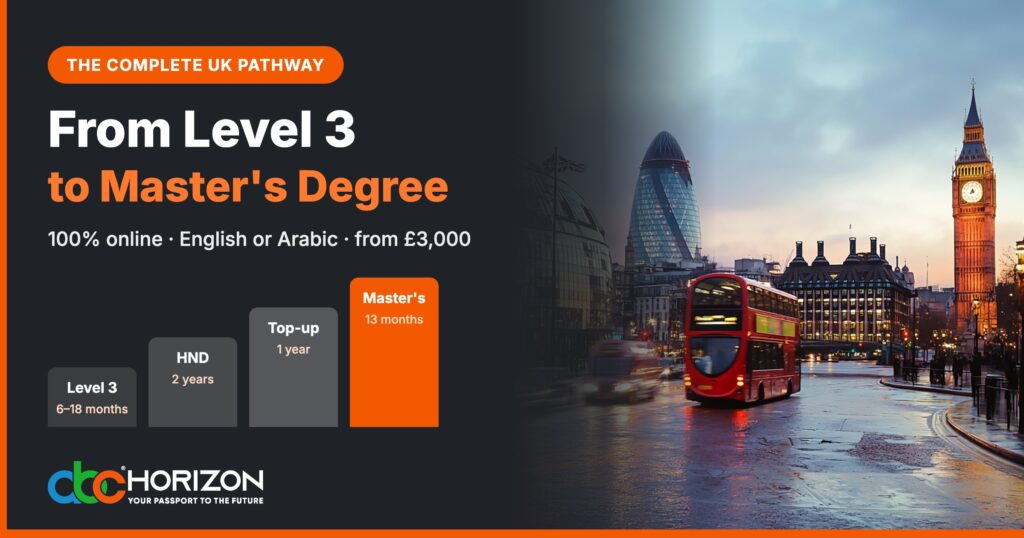
Yes, you can go from Level 3 to a UK master’s degree without A-levels. The route has four steps: a BTEC Level 3 (6 to 18 months), a Level 5 HND (2 years), a one-year top-up to a full bachelor’s degree with a UK university, and a 13-month master’s. You can study every step online while you work, in English or Arabic, and pay in instalments.
Tell us your latest qualification and we will show you which step you start from:
6–18 monthsLevel 4–5HND
2 yearsLevel 6Top-up bachelor’s
1 yearLevel 7Master’s
13 months
Can you get a master’s degree without A-levels?
Yes. In the UK, A-levels are only one way into higher education. A BTEC Level 3 qualification is worth up to three A-levels, and from there an HND, a top-up degree and a master’s take you to Level 7. Universities judge you on the qualification you hold at each step, not on whether you sat A-levels.
This is the route many adults in the UK use when they left school early, failed or skipped A-levels, or simply never had the chance to study. Every step leads to a real qualification on its own, so if you stop at any point you still keep a recognised certificate:
- Step 1 gives you a British High School Diploma (Pearson BTEC Level 3).
- Step 2 gives you a Higher National Diploma (HND) from Pearson or Qualifi.
- Step 3 gives you a full bachelor’s degree with honours from a UK university top-up.
- Step 4 gives you a Level 7 Postgraduate Diploma, then a UK master’s degree from the university.
What are UK qualification levels 3 to 7?
The UK groups qualifications by level. In England, Wales and Northern Ireland this is the Regulated Qualifications Framework (RQF) and the framework for higher education. Level 3 is the level of A-levels, Levels 4 and 5 match the first and second years of a degree, Level 6 is a bachelor’s with honours and Level 7 is a master’s.
| Level | What it equals | Qualification on this pathway | Credits |
|---|---|---|---|
| Level 3 | A-levels | Pearson BTEC International Level 3 (Subsidiary Diploma, Diploma or Extended Diploma) | 60 to 180 |
| Level 4 | First year of a bachelor’s | HNC (first year of the HND) | 120 |
| Level 5 | Second year of a bachelor’s | HND from Pearson BTEC or Qualifi | 240 in total |
| Level 6 | Bachelor’s degree with honours | Top-up degree awarded by a UK university | 120 |
| Level 7 | Master’s degree | Level 7 Postgraduate Diploma, then a master’s with dissertation from a UK university | Diploma + dissertation |
You can check any Pearson or Qualifi qualification on the official Ofqual Register of Regulated Qualifications.
How long does it take to go from Level 3 to a master’s?
About 5 years if you start with no qualifications: 6 to 18 months for Level 3, 2 years for the HND, 1 year for the top-up and 13 months for the master’s. If you already hold one of the steps, you skip it and finish sooner.
- Level 3: 6, 12 or 18 months. Three stages of 6 months each. Most students heading to a bachelor’s with us only need the first stage.
- HND: 2 years. Year one is Level 4 (HNC), year two is Level 5. You finish with 240 credits.
- Top-up: 1 year. 120 credits at Level 6 with a UK university, online. The university awards your bachelor’s.
- Master’s: 13 months. 9 months for the Level 7 Postgraduate Diploma, then 4 months on your dissertation with a UK partner university.
| Where you start | Steps you take | Time to a master’s |
|---|---|---|
| No school qualifications | Level 3 → HND → top-up → master’s | About 4.5 to 5.5 years |
| A-levels, BTEC Level 3 or another high school diploma | HND → top-up → master’s | About 4 years |
| HND or another Level 5 | Top-up → master’s | About 2 years |
| Bachelor’s degree | Master’s | 13 months |
Compare that with the traditional route: two years of A-levels, three years of university, then a one-year master’s, which is six years of full-time study and usually means you cannot work full time.
Step 1: Which Level 3 do you need?
You need the BTEC Level 3 stage that matches your goal. If you plan to continue to a bachelor’s with us, the 6-month Subsidiary Diploma (equal to 1 A-level) is enough. If you want offers from other UK and European universities, take the Diploma (2 A-levels) or the Extended Diploma (3 A-levels).
| Stage | Duration | Credits | Equal to | Fee | Best for |
|---|---|---|---|---|---|
| Subsidiary Diploma | 6 months | 60 | 1 A-level | £3,000 | Continuing with us in Computing, Business or Art & Design |
| Diploma | +6 months | 120 | 2 A-levels | £6,000 | Offers from private and public universities |
| Extended Diploma | +6 months | 180 | 3 A-levels | £9,000 | Universities that ask for 3 A-levels or an advanced subject |
The Subsidiary Diploma is open to every adult with no prior requirements, which makes it the right start for anyone who left school without qualifications. The Diploma and Extended Diploma ask for completed grades 10 and 11, or a Level 2 qualification. Choose your subject:
There are 4 intakes a year, assessment is through projects and assignments rather than one final exam, and you can pay in instalments.
Step 2: What is an HND, and why is it the smartest route to a degree?
An HND (Higher National Diploma) is a two-year UK qualification at Levels 4 and 5, worth 240 credits, which universities treat as the first two years of a bachelor’s degree. It is the smartest route because it costs a fraction of university fees, you can study it online while you work, and it leads straight into a one-year top-up.
With ABC Horizon you study a Pearson BTEC or Qualifi HND in English or Arabic, online from anywhere or in person in Istanbul or Damascus. An HND costs £6,000 in total, which you can pay in six instalments starting at £500. Popular HND subjects:
See all 28+ HND programmes on the UK Bachelor’s Degree page.
Step 3: How does a top-up turn your HND into a full bachelor’s degree?
A top-up is the final year of a UK bachelor’s degree, built for HND holders. You study 120 credits at Level 6 with a UK university, usually in 12 months, and the university awards you a bachelor’s degree with honours, the same award as a student who studied all three years on campus.
Our top-ups are fully online, with fees from £5,000 for the whole year. They are awarded by UK universities such as the University of Derby, the University of Central Lancashire and Wrexham University. Pick the top-up that follows your HND:
Compare all 14 programmes, universities and fees on the top-up degrees page.
Step 4: Which master’s can you join after a top-up?
After your bachelor’s you can take a UK master’s in about 13 months: a Pearson BTEC or Qualifi Level 7 Postgraduate Diploma in 9 months, then a 4-month dissertation with a UK partner university, which awards your master’s degree. Your dissertation must be in the same subject as your Level 7 diploma.
There are 15 master’s programmes across business, computing and other fields, including Strategic Leadership and Management, Accounting and Finance, Human Resource Management, Strategic Marketing, Information Technology, Software Engineering, Cyber Security, Artificial Intelligence, Data Science, Health and Social Care Management and Psychology. The Level 7 diploma starts from £3,500 (for example, Leadership and Management, in three instalments). Dissertation-stage fees depend on the university, so ask us for a quote.
Which subjects can you follow all the way from Level 3 to master’s?
The most complete routes are in business, computing and health and social care, where every step has a matching programme from Level 3 to Level 7.
| Field | Level 3 | HND (Level 5) | Top-up (Level 6) | Master’s (Level 7) |
|---|---|---|---|---|
| Business | BTEC Business | HND Business | BA Business Management and Strategy | Strategic Leadership and Management or MBA |
| Accounting | BTEC Business | HND Accounting and Finance | BSc Accounting and Finance | Accounting and Finance |
| Computing | BTEC IT | HND Computer Science | BSc Computer Science | Information Technology or Software Engineering |
| Cyber security | BTEC IT | HND Cyber Security | BSc Cyber Security | Cyber Security |
| Health and social care | Any BTEC Level 3 | HND Health and Social Care | BSc Health and Social Care Management | Health and Social Care Management |
How much does the full pathway from Level 3 to master’s cost?
Using the fees on our programme pages, the four steps start from about £17,500 in total, before the dissertation fee: £3,000 for the Level 3 Subsidiary Diploma, £6,000 for the HND, from £5,000 for the top-up and from £3,500 for the Level 7 diploma. Every step can be paid in instalments.
| Step | Fee | Payment |
|---|---|---|
| Level 3 Subsidiary Diploma | £3,000 | Instalments available |
| HND (2 years) | £6,000 | 6 instalments from £500 |
| Top-up bachelor’s (1 year) | From £5,000 | Depends on the university |
| Level 7 Postgraduate Diploma | From £3,500 | 3 instalments |
| Master’s dissertation | Ask for a quote | Depends on the university |
| Total before the dissertation | From about £17,500 | Spread over about 5 years |
For comparison, tuition fees for home students at universities in England are capped at £9,535 a year for 2025/26 (GOV.UK), so a three-year bachelor’s alone costs more than £28,000 before a master’s. Fees on this pathway vary by subject, university and intake.
Can you skip steps if you already have qualifications?
Yes. You join the pathway at the step that matches your highest qualification, so you never repeat a level you already hold.
- A-levels, a BTEC Level 3 or a high school diploma from any country: start at the HND. Grades and the year you finished do not matter.
- An HNC (Level 4): you may be able to join the second year of the HND.
- An HND, a Foundation Degree or a Level 5 diploma: go straight to the one-year top-up.
- A bachelor’s degree in any subject: go straight to the 13-month master’s.
- No degree but many years of senior work experience: you may be accepted onto a Level 7 diploma, subject to Pearson or Qualifi rules.
Qualifications from outside the UK can be compared with UK levels through UK ENIC. Send us your certificates and transcript on WhatsApp and we will tell you your starting step.
Who is the Level 3 to master’s pathway for?
It is for adults who want a university degree but do not have A-levels, or whose studies were interrupted, and who need to keep working while they study. Most of our students on this route are between 20 and 50.
BTEC Level 3, A-levels or an Access to HE Diploma: which is better for adults?
For working adults who want to reach a degree and then a master’s, a BTEC Level 3 with a direct path to an HND is usually the most flexible choice: it is online, it starts four times a year, it is assessed by coursework and it leads straight into the next step. A-levels suit school leavers, and an Access to HE Diploma suits adults who want to join a specific UK campus university.
| BTEC Level 3 (this pathway) | A-levels | Access to HE Diploma | |
|---|---|---|---|
| Level | Level 3 | Level 3 | Level 3 |
| Typical length | 6 to 18 months | 2 years | About 1 year |
| Assessment | Projects and assignments | Mainly final exams | Coursework |
| Where | Online, Istanbul or Damascus | School or college | Mostly at UK colleges |
| Language | English or Arabic | English | English |
| Next step | HND with us, then top-up and master’s | University application | University application |
All three are Level 3. The difference is speed, flexibility and what happens next: on this pathway your next step is already planned, so you do not have to apply to universities from scratch after each stage.
What jobs can each step lead to?
Every level opens a different tier of jobs in the UK. Level 3 opens supervisory and technician roles, the HND opens assistant manager and specialist roles, a bachelor’s opens graduate jobs and professional training, and a master’s opens senior and management roles.
| Level reached | Example roles in business | Example roles in computing |
|---|---|---|
| Level 3 | Team leader, administrator, sales supervisor | IT support technician, junior web developer |
| Level 5 (HND) | Assistant manager, HR or marketing officer, accounts assistant | Network technician, junior software developer, cyber security analyst trainee |
| Level 6 (bachelor’s) | Graduate schemes, manager, business analyst | Software engineer, systems analyst, cyber security analyst |
| Level 7 (master’s) | Senior manager, head of department, consultant | IT manager, security lead, data and AI specialist |
Many students also use each step to get promoted at the company where they already work, because each certificate is added to their CV as they go.
Can you study the whole pathway online while you work?
Yes. Every step is available online, attendance is optional and you can study in self-study mode, so the pathway fits around full-time work, shifts and family. You can also study Level 3, the HND and the Level 7 diploma in person in Istanbul or Damascus.
- Language: Level 3, the HND and the Level 7 diploma are taught in English or Arabic. The top-up and the dissertation are with the UK university, in English.
- Assessment: projects, research and practical assignments rather than one high-pressure exam.
- Intakes: several intakes a year, for example October and January for the HND and the Level 7 diploma.
Read more about studying online with ABC Horizon.
Is every step recognised by UK employers and universities?
Yes. Level 3, the HND and the Level 7 diploma are Pearson BTEC or Qualifi qualifications regulated by Ofqual, and the bachelor’s and master’s degrees are awarded by the UK universities themselves. Employers and universities see the same qualification names and levels used across the UK.
ABC Horizon is a Pearson approved centre (number 91667) and a Qualifi approved centre. Every certificate we issue can be checked on our certificate verification page, and degrees can be confirmed directly with the awarding university.
How do you start the pathway today?
- Send us your latest certificate on WhatsApp, or tell us you have none.
- We tell you your starting step, the subject that fits your career goal and the fees.
- Apply online using the application form and choose your intake.
- Pay the first instalment and start studying online.
Not sure where you fit? Ask an adviser, it is free:
Living in the UK and want the full one-year bachelor’s guide? Read UK bachelor’s degree online in one year.
Frequently asked questions
Can I go to university without A-levels in the UK?
Yes. A BTEC Level 3 is accepted in place of A-levels and is worth up to three A-levels. With us, the 6-month Subsidiary Diploma is enough to start an HND.
How many years from Level 3 to a master’s degree?
About 5 years if you start from nothing: 6 to 18 months of Level 3, 2 years of HND, 1 year of top-up and 13 months of master’s.
Is a BTEC Level 3 equal to A-levels?
Yes. The Subsidiary Diploma equals 1 A-level, the Diploma 2 A-levels and the Extended Diploma 3 A-levels.
Is an HND equal to two years of a degree?
An HND is 240 credits at Levels 4 and 5, which universities treat as the first two years of a bachelor’s, so you join the final year as a top-up.
Who awards my bachelor’s and master’s degrees?
The UK partner university where you complete your top-up or dissertation awards your degree.
Can I do a master’s after an HND without a bachelor’s?
Usually you first complete a one-year top-up to get your bachelor’s. Applicants with strong work experience may be considered for a Level 7 diploma directly.
How much does the whole pathway cost?
From about £17,500 for the four steps before the dissertation fee, paid in instalments over about 5 years.
Can I study in Arabic?
Yes. Level 3, the HND and the Level 7 diploma are available in English or Arabic.
Do I have to travel?
No. Every step can be completed online. In-person study is also available in Istanbul and Damascus.
Can I stop halfway?
Yes. Each step gives you its own recognised qualification, so you keep what you have earned.
Last updated: 29 November 2026. Fees are taken from the programme pages on our website and may change by subject, university and intake.