Microcredentials in Türkiye: Can Professional Courses Count Toward a Degree?
A practical guide to presenting professional skills, certificates and prior learning to a Turkish university for possible academic credit.
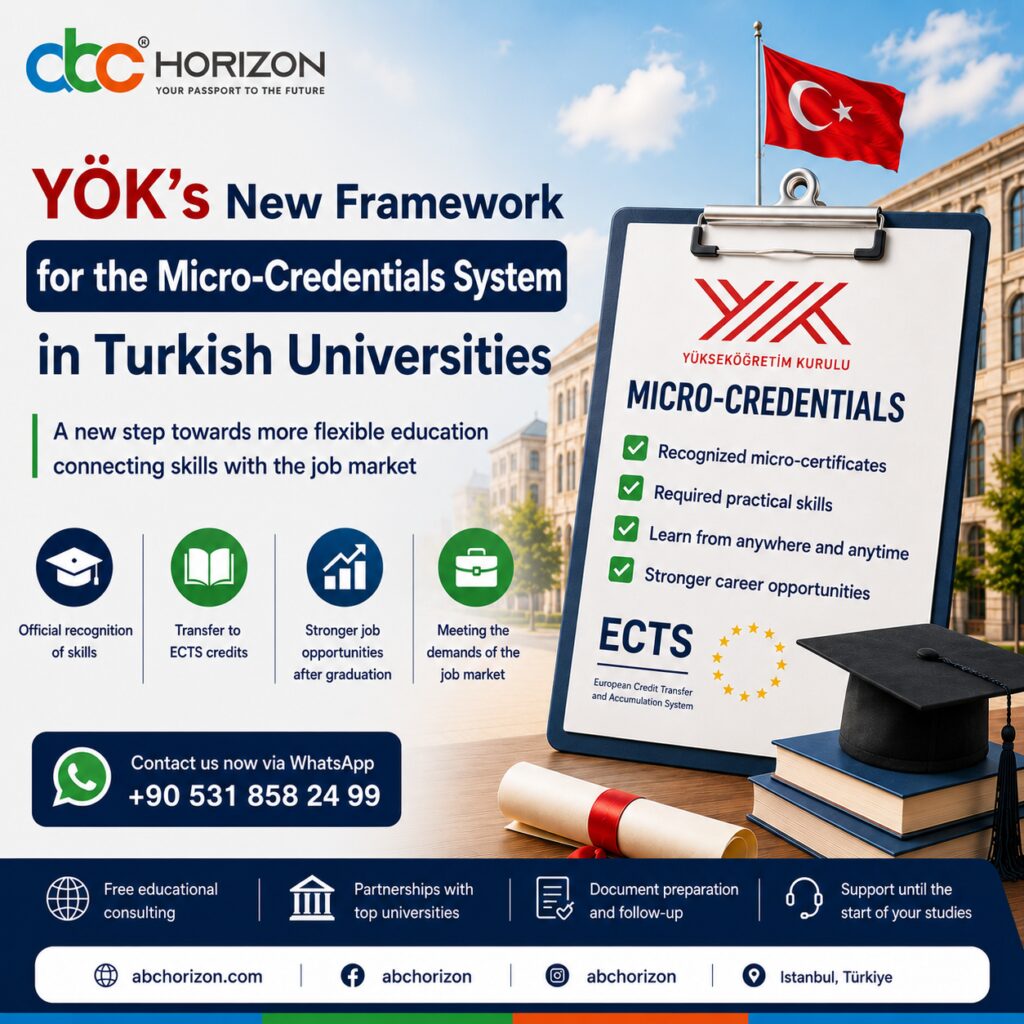
Yes. Under Türkiye's microcredentials framework, a Turkish university may assess eligible professional courses and certificates earned outside the university and convert approved learning into ECTS credit. Recognised micro-credentials may account for up to 10% of the total credits required for graduation, but acceptance is not automatic and remains subject to university rules and academic approval.
Many students arrive at university with practical skills already developed through a training centre, technology academy, online programme or workplace. A web developer may have built real projects, a designer may hold a strong portfolio, or an automation technician may have completed hands-on PLC training. The natural question is: Can this professional learning become part of my academic record instead of remaining only on my CV?
Türkiye's Council of Higher Education has introduced a framework through which universities can evaluate short, focused and verified learning completed outside conventional degree courses. When a university approves the learning, it may be converted into ECTS credit and recorded in the transcript or diploma supplement according to institutional policy.
What are microcredentials, and how can they become university credit?
Microcredentials are short, focused and assessable learning achievements that verify specific knowledge or skills. Academic recognition means comparing the knowledge and skills demonstrated by a microcredential or professional course with the learning outcomes of a degree programme. If the evidence shows substantial alignment, the university may award credit, grant an exemption or record the recognised learning in another way allowed by its regulations.
The title of a certificate is rarely enough on its own. Academic reviewers may examine the syllabus, study hours, learning outcomes, assessment method, provider, practical projects and relevance to the student's degree.
Why are Turkish universities recognising learning beyond campus?
Technology and industry often move faster than traditional curricula. Artificial intelligence, digital production, web development, automation, visual communication and digital marketing continuously create new skill requirements. A structured recognition system allows universities to evaluate current, measurable learning without lowering academic standards.
Under the official Micro-Credentials Framework, approved learning may be expressed in ECTS credits. The announced model allows recognised micro-credentials to represent up to 10% of the credits required for graduation, while university senates determine which courses and programmes they will accept.
From professional course to university credit
Structured learning
A course with a clear syllabus, duration and learning outcomes.
Verified competence
An exam, project or portfolio that proves what was achieved.
Academic review
Evidence submitted to the department or responsible committee.
University decision
Approval, rejection or an additional assessment and credit decision.
How much university credit can be recognised?
The announced ceiling is 10% of the total ECTS credits required for graduation. For example, the theoretical maximum would be 24 ECTS in a 240-ECTS programme or 12 ECTS in a 120-ECTS programme.
These examples explain the maximum only. A university may recognise fewer credits, impose its own internal limits, request another assessment, or decide that a particular course is useful but not equivalent to a credit-bearing part of the degree.
What makes a professional certificate suitable for assessment?
- The learner's identity can be verified.
- The provider and completion date are clearly stated.
- A detailed syllabus is available.
- Theory and practical study hours are documented.
- Learning outcomes are specific and measurable.
- Competence is tested through an exam or project.
- A final grade or pass result is recorded.
- Projects or a portfolio support the application.
Can professional experience be recognised without a course?
Work experience may strengthen a recognition of prior learning application, but years of employment alone do not describe exactly what a student knows or can do. A university may request job descriptions, employer letters, work samples, a portfolio, an interview or a competency test. Experience supported by structured training and verified assessment usually creates a clearer evidence file.
How to submit a professional course for assessment
- Check your university regulations: look for recognition of prior learning, course exemption or micro-credential policies.
- Contact your academic department: identify the module or learning outcome that may correspond to your training.
- Prepare the course file: collect the syllabus, hours, outcomes, delivery method and assessment details.
- Add proof of competence: include your certificate, grade, projects, portfolio and relevant experience.
- Arrange translation if required: follow the university's instructions for Turkish translations or certification.
- Complete any university assessment: you may be asked to take an exam, attend an interview or submit another project.
- Obtain the decision in writing: confirm the credits awarded and how they will appear in your academic record.
A strong course record versus attendance only
| Evidence | Strong for assessment | Attendance certificate only |
|---|---|---|
| Learning outcomes | Specific and measurable | Often unclear or missing |
| Assessment | Exam or practical project | No proof of competence |
| Study hours | Documented by topic and activity | May not be stated |
| Academic comparison | Easier when content aligns | Difficult without evidence |
Professional learning at ABC Horizon
ABC Horizon provides educational and professional programmes designed to connect knowledge with practical application. Structured training can help learners develop demonstrable skills and build an evidence file that is more useful than undocumented self-study alone.
A learner may submit an ABC Horizon certificate and supporting course documents to a university for assessment. This does not guarantee credit: the university considers relevance to the degree, evidence quality, assessment standards and its own academic rules.
Professional programmes for documented skill development
Choose a field that supports your degree or career objective, and retain the syllabus, assessment result and practical projects from the beginning.
Before enrolling for the purpose of academic credit
Send the course description to your academic department and ask whether its learning outcomes could correspond to a module or recognised skill in your programme. Request written preliminary guidance where possible, while remembering that preliminary feedback is not the final committee decision.
20 frequently asked questions about microcredentials and university credit
1. Can a Turkish university recognise my professional course?
2. What are microcredentials?
3. Is the 10% credit allowance guaranteed?
4. Will every training provider be accepted?
5. Can an ABC Horizon certificate be assessed?
6. Is an online course less valuable than classroom training?
7. Must the course be taught in Turkish?
8. Is the certificate alone enough?
9. Can work experience be recognised without a training certificate?
10. Can a course unrelated to my major receive credit?
11. Can I submit several certificates together?
12. Can recognised credit shorten my study period?
13. Where do I submit a recognition request?
14. Can the university test me even if I have a certificate?
15. Will recognised credit affect my grade point average?
16. Can Türkiye recognise a professional course completed abroad?
17. What if my certificate does not state the study hours?
18. Is a portfolio important for design and programming courses?
19. When will the new system be implemented?
20. How can I improve the chance of recognition?
Build skills that support your academic and career goals
Contact ABC Horizon to explore professional programmes, delivery options and the training documents available to learners before submitting them to a university for assessment.
Contact us on WhatsApp